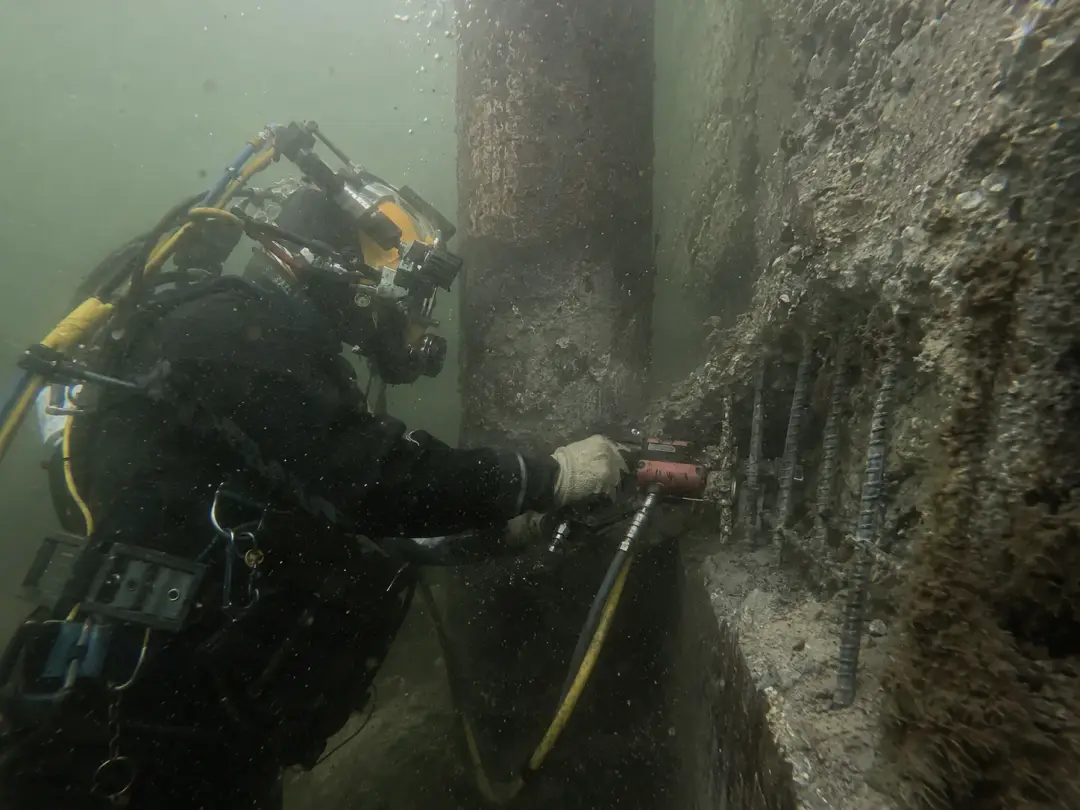
On a quay, a pier or a breakwater the most vulnerable part is under water — where it cannot be seen when walking the coping. Piles lose section, ground is washed out from under the slab, concrete breaks down in the splash zone. From the outside the structure still looks serviceable. An underwater survey is the only way to learn the actual condition of the structures before a defect turns into a failure or a ban on operation. Here is when a survey is mandatory, exactly what divers look at and what documents the owner receives.
Why a quay needs an underwater survey
A marine structure works in the most aggressive environment there is: a changing water level, ice, wave loading, vessels coming alongside, sea salt. Deterioration almost always starts from below and stays invisible for a long time. By the time settlement or a crack shows on the surface, the process has been going on underwater for years.
The second reason is legal. The owner of a marine structure is required to monitor its technical condition and to document its safety. Without current survey material it is impossible to design a repair, to justify safe operation to the regulator, or to hand the asset over properly on a change of owner or a lease.
The third is economic. Local scour under the foundation, found in time, is dealt with locally. The same scour three years later means settlement of the slab and reconstruction of a section of the quay.
When a survey is mandatory
For port marine structures the rules for surveying and monitoring technical condition are set by the Russian standard GOST R 54523-2011. The standard distinguishes several types of survey, each with its own trigger:
- Initial
- carried out on a structure for which there is no reliable condition data: the asset was taken over without documentation, has not been surveyed for a long time, or has changed owner.
- Periodic
- a scheduled survey as part of routine condition monitoring. The interval is set according to the type, age and operating conditions of the structure.
- Extraordinary
- after an event capable of damaging the structure: a vessel coming alongside heavily, ice loading, a storm, an accident — and also when visible deformation appears, such as settlement, cracks or tilt.
- Pre-declaration
- carried out when preparing the safety declaration for the structure. It produces the pre-declaration survey report — the document without which the declaration cannot be approved.
A separate trigger is preparation for repair or reconstruction. The designer needs actual data on the condition of the underwater part: without it the design is done blind, and quantities appear on site that were never in the budget.
What is hidden underwater: the usual defects
The set of defects depends on the type of structure, but most often divers record:
- Corrosion of steel
- loss of section in sheet piling and piles, especially in and below the splash zone, where steel deteriorates fastest.
- Concrete deterioration
- spalling, voids, exposed and corroding reinforcement, breakdown of the joints between blocks.
- Scour and undermining
- ground washed out from under the slab or pile cap, voids behind a sheet-pile wall — the most dangerous defect, because nothing but an underwater inspection will reveal it.
- Impact damage
- deformation, dents, sheared fender components, displaced blocks.
- Condition of anchors and ties
- corrosion, slackening and failure of anchor rods.
- Siltation and foreign objects
- changes in bed levels at the wall, sunken timber, lengths of wire rope and submerged debris that interfere with mooring and with vessel operations.
How the survey is carried out
- 1
Reviewing the documentation
Before going on site we establish what we are surveying: the type of structure, the drawings, the levels, the history of repairs and previous surveys. That determines the inspection pattern and the measurement points.
- 2
Dividing into sections
The structure is divided into sections referenced to bollards or markers. Every defect is then tied to a specific section — otherwise the report makes it impossible to find the damage again.
- 3
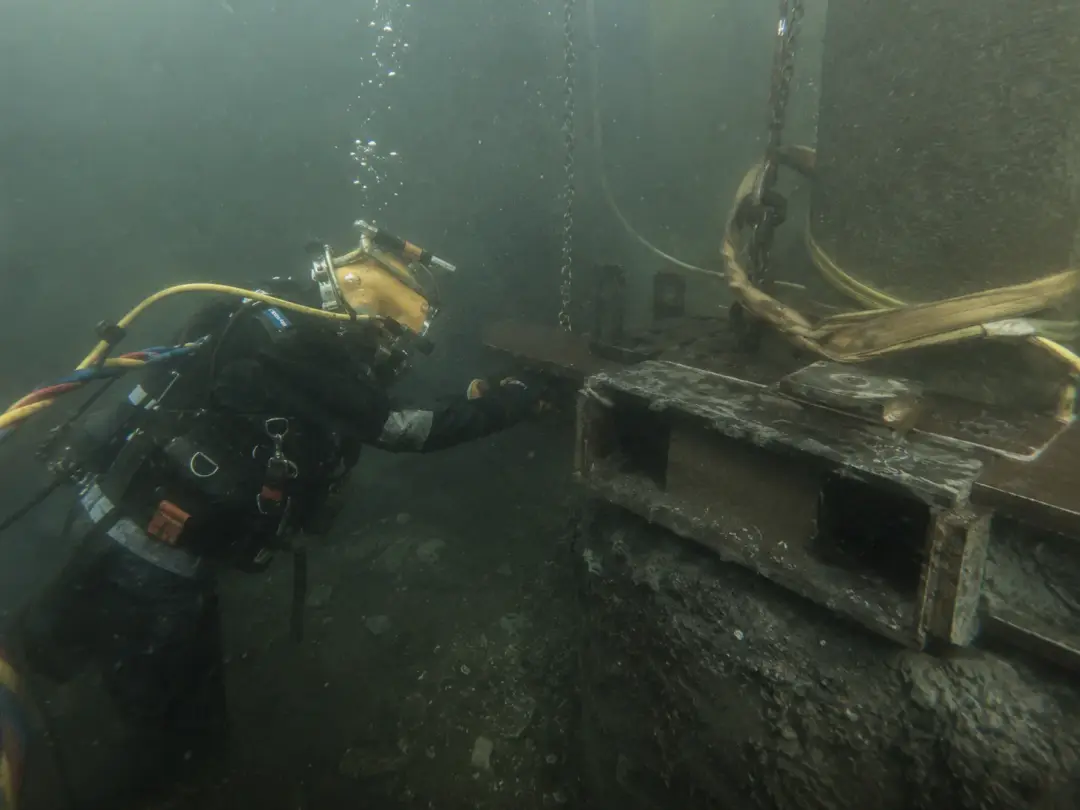
The diver inspection
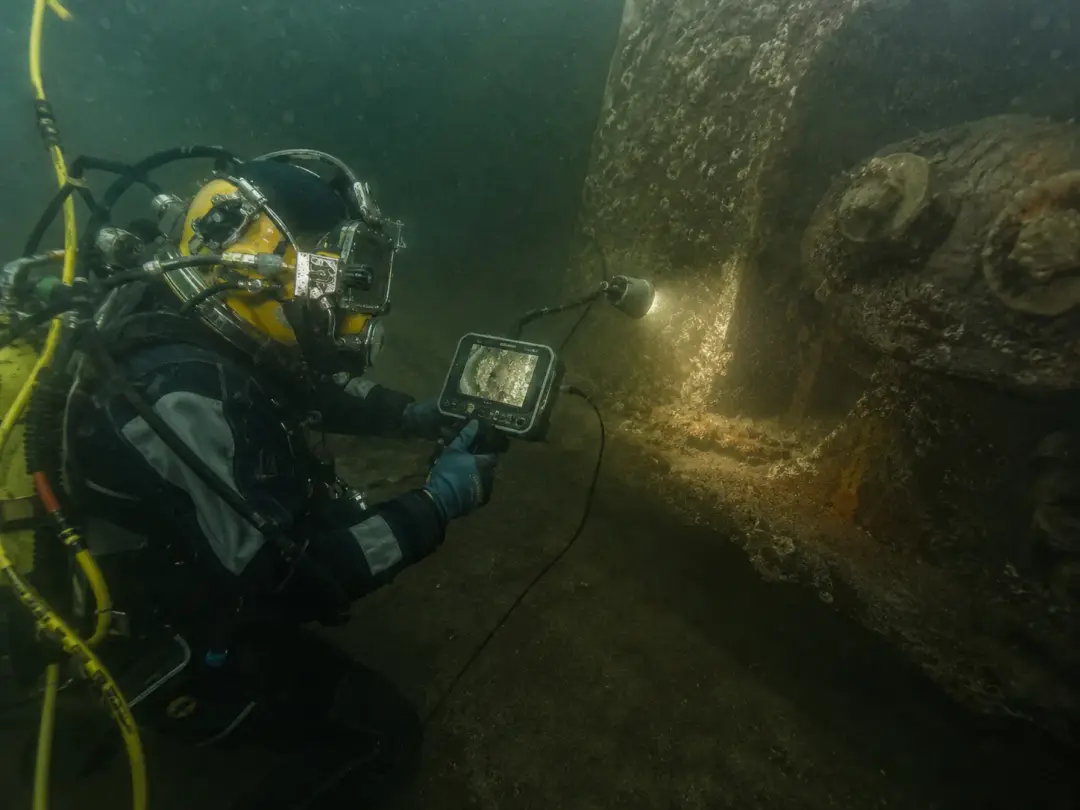
The diver works his way along the underwater part to an agreed pattern under live video over the umbilical: the supervisor on the surface sees the picture in real time and directs the inspection. The general view and hard-to-reach areas are filmed with the RB-550 ROV, while GLONASS/GPS and sonar positioning fix the location of each finding.
- 4
Cleaning and measurement
To assess steel or concrete, the area has to be cleared of fouling — we apply cavitation cleaning locally, which removes growth and corrosion products without damaging the substrate. On the cleaned patches we take residual thickness measurements and sound the depths at the wall.
- 5
Compiling the material
Video, photographs, drawings locating the defects and the measurement results are brought together into a report. The material is handed to the client and, where required, to the design organisation preparing the assessment and the repair design.
What the client ends up with
- Video and photographic material for every section — evidence, not just a written description.
- A drawing locating the defects found on the sections of the structure.
- Measurement results: residual steel thicknesses, depth soundings, dimensions of voids and scour.
- A defect schedule describing the nature and extent of the damage.
- Material in a form suitable for handing to a designer and for attaching to the survey report.
It is worth being clear about who does what. The diving contractor carries out the underwater part of the work and documents the actual condition of the structures. The final assessment of technical condition, the calculations and the safety declaration are prepared by a specialist organisation with hydraulic engineers — on the basis, among other things, of our material. If you already have such a contractor, we work alongside them and hand over the data in the form they need.
What is particular about Kola Bay
Kola Bay does not freeze, so quays here can be surveyed all year round — including through the polar night, when the work is done under artificial light. In the Arctic that matters: the asset does not wait half a year for a season.
The difficulties come from tides, currents and limited visibility. The inspection is planned around the tidal cycle, the splash zone is examined at a suitable state of tide, and hot-water suits let the diver work a full shift underwater rather than in short bursts.
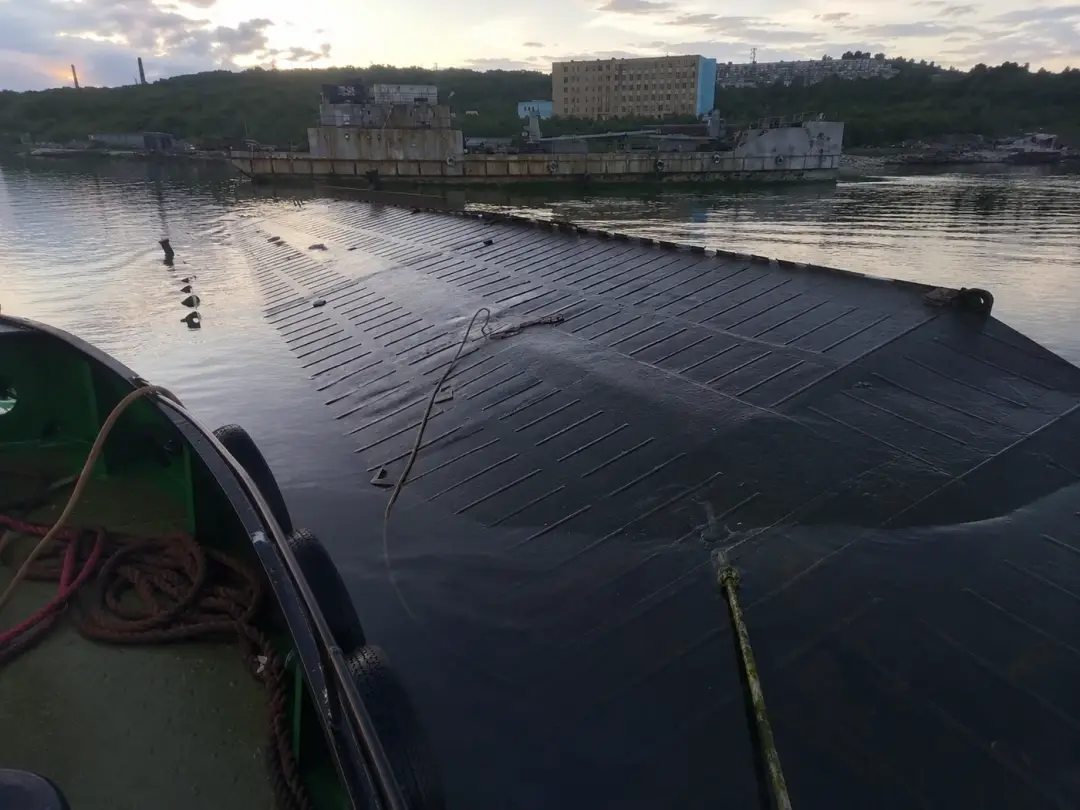
PKF Bolid LLC has carried out underwater work in Murmansk since 1992, at depths to 60 metres. We have surveyed and repaired quay structures at ship repair and mining facilities — for example, we worked on a floating pier in Severomorsk and supported the works at Shipyard No. 35.
Frequently asked questions
- Does the quay have to be taken out of service for the survey?
- As a rule, no. The survey is carried out from the water and does not require the whole structure to stop working — all that is agreed is temporarily keeping the section under survey free of moored vessels and stopping work in the dive area.
- How often should a quay be surveyed?
- The interval depends on the type of structure, its age and its operating conditions, and is set as part of routine condition monitoring. An extraordinary survey is carried out immediately after a heavy contact, ice loading, a storm or the appearance of visible deformation — regardless of the schedule.
- Do you prepare the safety declaration for the structure?
- We carry out the diving part of the survey and hand over a complete set of material on the actual condition of the underwater structures. The assessment of technical condition and the declaration are prepared by a specialist organisation with hydraulic engineers — we work alongside them.
- What should be done if scour is found under the slab?
- First, record the actual dimensions of the void and judge whether it is growing. Some of the work is done underwater without taking the structure out of service — from sealing local washouts to [restoring the structures](/en/services/marine-structure-repair). The decision is taken together with the designer on the basis of the survey.
- Can the survey be done in winter?
- In Kola Bay, yes — the water does not freeze and we work all year round. On frozen waters we arrange the dives through an opening in the ice, as we do on winter projects.